Friday, May 6, 2016

Looking at Pupa!

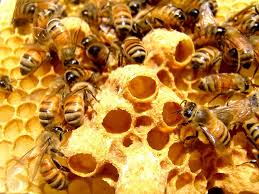
Everyone who had their honeybees arrive on 4/23/16 should see eggs, larva, and now pupa! Below are photos of pupa patterns. The workers have secreted wax and sealed the brood with a thin layer of wax for the third stage of the metamorphosis. Within the next 10-15 days our first baby bees will be hatching out. When you do your hive checks you can look for their little heads as they chew their way out of the cells. I have re-queened one of my personal hives and two others. If you don't see eggs, larva and pupa by now your hive may bee queenless. Call an experienced beekeeper to have a look at your colony if this is the case! I have removed my outer insulation and still have the inner insulation frames in my hives. Sugar feeding should be complete by May 15th since we should be seeing more dandelions by then. Colonies at higher elevations or cooler locations may need to feed longer.

 Pupa - "Capped Brood" - The third stage of the metamorphosis of insects.
  1. "An insect in its inactive immature form between larva and adult, e.g., a chrysalis." (Google)

  2. Hatched Out Queen Cell - If a queen has already hatched out this is what you will find.
     
    Female Honeybee Birth
    Queen Bee Cell


    Queen Bee Cells
    -Remove queen cells to prevent swarming!!
    Queen Bee Cells


Sunday, May 1, 2016

First Complete Hive Check of the Season

Today was a beautiful day for complete hive checks! I removed the empty queen cages and am storing them in my tool box until fall when I will cage my queens. My queens are laying beautiful patterns of eggs and within the next 14 days baby honeybees will be born by the hundreds every day all summer, Lord willing. I marked a couple queens today. I will continue to feed my bees sugar water for one more week (about 1-2 more feedings), since I have drawn-out comb. For those who are using mostly bare foundation, you may want to feed sugar water until the middle or end of May in order to encourage wax building. Another way to entice faster wax building is to spray sugar water on bare foundations.I pulled off the outer insulation today and left the inner insulation boards on each side of the brood box. Next weekend would be a good time to add a second brood box below the first box because we want the babies warm and every good scientist knows that heat rises!
From the Science-Based Art of AK, LLC Beekeepers Calendar:
April 29th – May 1st: First Queen & Complete Hive Check (50* or warmer) Looking for eggs & larva (Do not look for queen if it is too cold) If you find no eggs, check again in three days. Do not let sugar water run out!
Keep filling feeder(s) every 3-5 days without doing a full hive check.

See Photos for examples of 
brood patterns.
Healthy pattern of eggs (1-2 days old)


Healthy larva (4-7 days old)

Healthy Larva (7-10 days old)

Spotty (Poor) Queen Pattern

Dead Queen - Laying Worker Eggs (Kill Bees!)

Wednesday, April 27, 2016

Summer Camps for Children in 2nd Through 12th Grades

Hey Ya'll!

This is Stephen! Kaylee and I are super excited to start these summer camps. It's going be a world of fun, so if you are interested in signing your child up for a Science Based Art summer camp, please check out the link:  "Summer Camp Registration" just under the blog head photos above. Every detail you need to know about each camp is located at that link, so click away! Hope to see you this summer!!


Sunday, April 24, 2016

This is the best start my honeybees have ever seen! The weather is unbelievably warm.
I am very impressed once again with Steve and Donna Victors transportation of our bees! For those of you who did not order early enough to obtain bees from the Victors shipment, please consider ordering earlier next year and Steve shared he will have several hundred more colonies available for the Fairbanks shipment next year. If the weather holds hive manipulation will be different than previous years so check in on this blog regularly as I will communicate what I am doing each time I work with my hives through the season.

From the Science-Based Art Beekeepers Calendar:
April 29th – May 1st: First Queen Check (50* or warmer) Looking for eggs & larva (Do not look for queen if it is too cold) If you find no eggs, check again in three days. Do not let sugar water run out!
Keep filling feeder(s) every 3-5 days without doing a full hive check.

I will be filling sugar feeders on 4/26/16 when it is 50* or warmer. 
I am pulling out entrance reducers by 11 AM and reducing my entrances to the smallest setting by 7 PM.

Blessings for your first week of beekeeping in 2016!
~ Dawn

Saturday, April 16, 2016

APRIL 23rd, 2016 - Arrival of Honeybees from California Almond Fields

One week from today we are expecting the arrival of our beloved honeybees from California. Steve and Donna Victors will receive the bees at Anchorage International Airport and drive them up to Fairbanks in an air conditioned trailer. The estimated time of arrival in Fairbanks will be posted here on this blog by Saturday morning 4/23/16.
Reminders:
1)  Bring equipment inside 24 hours before hiving your bees.
2) Make sugar water (at least 1:1) 24 hours ahead and at room temperature at the time of hiving. (Having a weak sugar syrup can cause bees to expire, but don't over-do it either).
3) Have internal and external insulation ready.
4) Have a chemical-free spray bottle ready.
5) Mini-Marshmallows are available for free when the bees arrive.
6) Have pollen patty at room temperature ready. (Pollen patties will be available for sale when the bees arrive for $5.00 each.)

In past years beekeepers have been known to wait about an hour in the Monroe parking lot (Gym side of bldg.) Please be patient as exact time of arrival is tough to predict. If you do have to wait, bring a good book or plan on mingling with other beekeepers while you wait.

Blessings to all for a great season of gardening and beekeeping! 

Wednesday, April 13, 2016

Science Based Art Summer Camps!!

Hey Ya'll!

This is Stephen! Kaylee and I are super excited to start these summer camps. It's gonna be a world of fun, so if you are interested in signing your child up for a Science Based Art summer camp, please check out the link below. Every detail you need to know about each camp is located at that link, so click away! Hope to see you this summer!!


Click here for Summer Camp Sign-ups!!

Friday, March 11, 2016

Beekeeping Classes with Dawn Cogan

Beginning and Intermediate Beekeeping with Dawn Cogan

Beekeeping Classes with Science-Based Art


Science-Based Art
Instructor: Dawn Cogan 
To register, email Dawn at sciencebasedart@yahoo.com or call Dawn at (907)460-6050.

Cost: $150 per family

Sat. 2/11/16 1-5 PM & Sun. 2/12/16 1-5 PM (4 hrs. each day for a total of 8 hrs.) Monroe Catholic School 

• What is beekeeping? How much honey will I get? How much will this all cost me?
• Equipment necessary to keep bees in Alaska
• Biology and races of honeybees
• Members of the hive and their duties
• Where can I get bee equipment? Should I get new, used or build my own?
• Getting equipment ready for the arrival of bees

  • Hands-on Project: Construct a beehive in class
• Insulation, feeding bees properly
• What to do when the bees arrive
• Is my queen marked? (queen marking tool)
• Management of honeybee colonies in Alaska, the beekeepers calendar
• Running 2-Queen Hives
• Swarming and how to prevent it
• Honeybee diseases
• Extracting your Alaska honey
• What to do at the end of the season/wintering over
• Storing your equipment
• Beeswax candle making

Steve Victor's Honeybee Shipment Delayed to Interior by 7 Days!

Good Morning Beekeepers,
As part of our bee order we closely track the developing conditions in California and report any new developments that may affect our schedule for bee delivery.
As you know, our goal is to deliver the highest quality package possible.  We know that our delivery time is an exciting event that is often planned by beekeepers well in advance of the actual day.  We have a few beekeepers who schedule the day off from work as well as some who arrange travel schedules around the arrival date that they picked out.  It is for this reason that we monitor the situation in California and report any event that may interrupt our planned schedule.
With the El Nino year there have been a number of challenges that our supplier (and all California bee suppliers) have had to overcome, many of these were discussed at the last beekeepers meeting.  For those who were not at the meeting here is a shortened discussion of some of the factors discussed:

1.     Weather Factors as they pertaining to mating flights of our queens: 
    As you know, there is a 10 day period in which a queen must mate with multiple drones to have the fertility she needs to reliably create worker brood.  This event occurs approximately 2 weeks prior to the filling of our packages.  Several mating flights must be made to accomplish this.  The weather must be warm and dry with little wind.  Normal spring conditions in California give us these.  On an El Nino year weather conditions in the month of March can be quite poor for predictable mating flights.  This is an El Nino year.  Typically the weather improves in the latter half of March.  It is the first batch of queens that have the most difficulty finding good mating weather.
2.     El Nino years also affect the almond bloom:
    It is in the almonds that our hives are placed in early spring.  The incoming pollen flow stimulates the brood rearing of the hives allowing them to grow.  After the almond bloom, hives are moved out of the almonds full of workers and developing brood.   These large hives are where we find our surplus bees.  Removal from the almonds is the start of swarm season for these hives.   Just as swarm season varies for us from year to year because of the arrival of the spring bloom and subsequent growth of the hive, it also does the same in California.  A slow wet spring results in fewer surplus bees in early April.
3.     Wet flowers on the almond trees can affect the hives as well:
    The almond bloom goes through several stages, four of which are mentioned here: Popcorn, bloom, petal fall, and jacket. All of these stages overlap to some degree within an orchard as some trees are slightly ahead and some slightly behind the others.  Naturally, it is understood that bloom is where our bees are working, collecting pollen, and the brood rearing is the greatest.  At the end of the bloom is an event called petal fall.  Ideally, the almonds are pollinated and the flower petals fall off the flower in a gentle dry breeze.  A rainy season of an El Nino year can wet the petals causing them to stick.  As the nut develops into the jacket stage and the wet petals are still on the tree, mold can form on the petals and jackets potentially ruining the almond crop.  Growers often spray fungicide on the trees when these conditions are present.  While the fungicides are approved for spraying orchards in the presence of hives there are negative impacts.  The primary impact is in the nutritional value in the pollen collected after the fungicides are sprayed on the orchards.  This slows the growth of the hive and even though the event happens long before our packages are filled and the bees placed into the packages are not from that generation, the overall hive population is smaller and fewer bees can be removed for our packages.
We have been in contact with our supplier to monitor the developments. We have learned that as of 2 weeks ago bees were in short supply and predicted to be behind schedule.  Two major producers of queens and package bees were canceling orders and delaying delivery of packages. This is both Koehnen as well as Heitkam.
As many of you know I have been closely monitoring the weather patterns in California this spring.  We have yet another wave of poor weather in the Sacramento Valley working its way through the area in the next several days.  This coincides with the grafting raising and mating of our queens.  

There is now enough information for me to predict that our bee shipments are very likely going to be delayed for a week while this latest round of weather works its way out of the Sacramento Valley.  This next week will be critical in determining if we are able to keep our schedule.  If I were a betting man I would say that there was an 80% chance of having the bees delayed and a 20% chance of meeting the original schedule.

The result will be that all weeks will need to be shifted by 7 days.  Delivery scheduled for the 9th will happen on the 16th.  Delivery for the 16th (Fairbanks and Kenai Peninsula day) will be on the 23rd.  Our third shipment scheduled for the 23rd will arrive on the 30th.
This is the first time in many years that we may not be able to meet our original delivery dates.  While almost all of our beekeepers will be able to adapt to the new schedule, we realize that there are some who will not be able to alter their spring schedule.  We apologize for the inconvenience this might cause but it is necessary to provide well mated queens with our packages.  If it does become necessary to shift our delivery schedule we will cancel  orders and refund any of our beekeepers who find that the new schedule does not work for them. 

Within a week I will be sending out another email confirming our schedule and letting you know if a shift in delivery dates is necessary.